Why Choose Liposomal Vitamin B9 for New Products?
Oct 18, 2026
If you're building a new supplement line and wondering where to start, liposomal vitamin B9 deserves serious attention. Unlike conventional folic acid tablets that depend on gut absorption pathways easily disrupted by digestive conditions or genetic variants, liposomal vitamin B9 wraps the active folate molecule inside a phospholipid bilayer. This structure mirrors human cell membranes, allowing direct cellular uptake. The result is measurably higher bioavailability and consistent nutrient delivery—attributes that translate directly into product differentiation and stronger consumer trust in competitive markets.
Understanding Liposomal Vitamin B9 and Its Unique Benefits
The Science Behind Liposomal Encapsulation
Liposomal vitamin B9 is made up of phosphatidylcholine nanoparticles, which are about 100 to 200 nm across. Acid in the stomach can't break down the folate through these pockets. For uptake, endocytosis is used instead of passive diffusion. This method skips the Reduced Folate Carrier, a transporter that is saturated at higher amounts. With this process, liposomal folate really helps your body absorb folate better than other vitamins.
Addressing the MTHFR Polymorphism Problem
Ten to fifteen percent of people in North America have two copies of the MTHFR C677T variant. It is now harder for them to turn synthetic folic acid into 5-methyltetrahydrofolate, which is a useful form of folate. When 5-MTHF is mixed with liposomal vitamin B9, like in Quatrefolic®, the functional form that has already been changed is passed on. This means that a lot of people can use it.
Clinically Relevant Benefits for End Users
Folate levels rise more when you take 5-MTHF supplements than when you take folic acid pills in the same amounts, according to a study published in the European Journal of Clinical Nutrition in 2014. This means that when you make your product, your customers get clinical evidence instead of just marketing claims. This is especially important for women who want to have children and people who need to control their homocysteine levels.
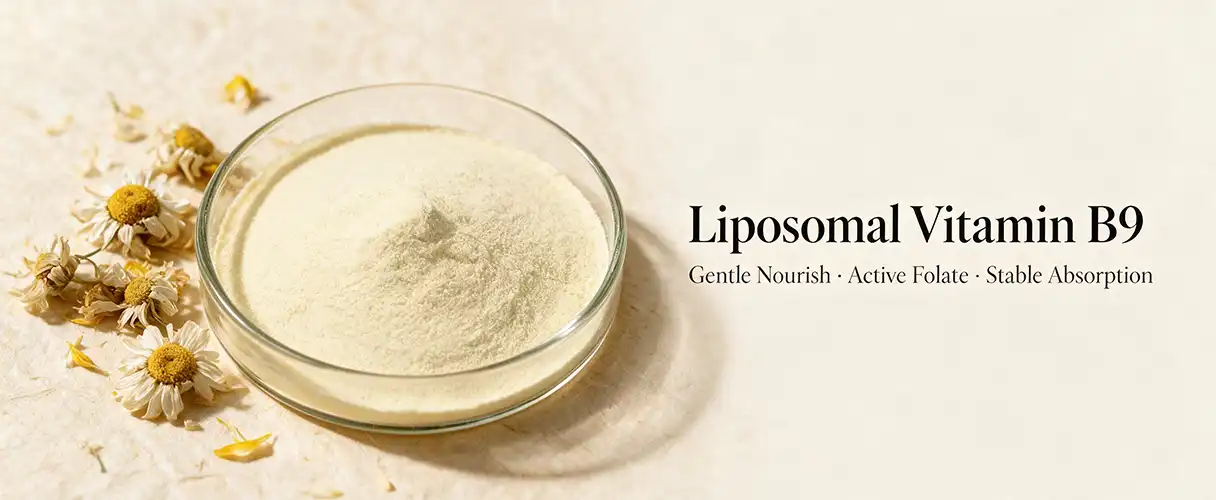
Comparing Liposomal Vitamin B9 with Traditional Forms
Absorption Rates and Bioavailability
This kind of folic acid needs to be broken down by enzymes in order for the body to use it. Particularly when it contains a lot of methylfolate, liposomal vitamin B9 completely skips that step. Studies have shown that liposomal delivery has a higher peak plasma concentration (Cmax) and a larger area under the curve (AUC) than both chewable tablets and regular tablets.
Delivery Format and User Compliance
If you take traditional B9 pills and have an acidic stomach, they won't work as well. The liver needs to change them several times. It is easier to digest liposomal forms, which come in liquid or softgel capsule form. They don't leave behind a bitter metallic taste at high amounts and stay stable across a wider pH range. The phospholipid shell also stops B9 from breaking down when it comes in contact with UV light, which is a common issue when making ready-to-drink (RTD) healthy drinks.
Natural vs. Synthetic Sourcing Considerations
The choice of sources affects where a company stands in the market. Sunflower lecithin is cheap and good for making many things. Phosphatidylcholine is good for people who don't want to eat GMOs or allergens. Brands that want to sell high-end supplements in the US can make more honest claims about the ingredients they use by saying that the liposomal vitamin B9 comes from sunflowers.
Procurement Considerations for Liposomal Vitamin B9 Products
Verifying True Liposomal Grade vs. Emulsion
Not everything that says "liposomal" actually is what it says it is. To make sure the particles are between 100 and 200 nm in size and the Polydispersity Index is less than 0.3, procurement professionals should get confirmation from a third party using Dynamic Light Scattering (DLS). It must have an Encapsulation Efficiency (EE%) of more than 85–90% for something to really be liposomal grade. Products with less than this amount are more like simple emulsions and won't help your customers absorb as they expect. When you check out a supplier, these are the most important things to look for:
- Transmission Electron Microscopy (TEM) or Cryo-SEM: Visual confirmation of spherical bilayer structures, proving genuine liposome formation rather than emulsion blending.
- HPLC Potency Testing: Quantifies the exact B9 payload and verifies phospholipid purity—critical for label accuracy and regulatory submissions in the US market.
- Stability Stress Testing: Evaluates oxidation markers (Peroxide Value) and leak rates under accelerated temperature conditions to confirm 12–24 month shelf-life viability with nitrogen-flushed airtight packaging.
These checks protect your company from poor quality and help you meet FDA and FCC rules without having to spend a lot of money on re-formulating later.
Cost Drivers and Pricing Negotiation
Liposomal vitamin B9 costs more than regular folic acid because it needs very pure phosphatidylcholine as a base ingredient and a tricky way to make stable nanostructures on a large scale, either through high-pressure homogenization or microfluidics. When talking about bulk pricing, make sure you get price lists that are based on the size of the order. Also, look at stability data from at least two production batches before making a choice.
Packaging, MOQ, and Regulatory Compliance
LIPO forms that are liquid need to be packed in containers that have been flushed with nitrogen to keep them from going bad. Capsule formats are more stable when shipped to room temperature. Make sure that the company you choose can handle both small R&D tests and big production runs. This product must meet the FDA 21 CFR Part 111 (dietary supplement GMPs) requirements in order to be sold in the US. For each batch, you must ask for a Certificate of Analysis (CoA).
Strategic Advantages of Incorporating Liposomal Vitamin B9 in New Product Lines
Tapping into Premium Market Growth
The market for liposomal supplements was worth about USD 330 million around the world in 2022. The rate of growth is expected to be over 8% per year until 2030 (Grand View Research). Very quickly, more and more people are looking for scientifically proven high-absorption formulas. It's especially true for US adults between the ages of 25 and 45 who care about their health. Your brand will fit right in with these high-margin items if you base a line of them on liposomal vitamin B9.
Differentiation Through Formulation Innovation
Most folate products sold in shops in the US still use basic folic acid. It is possible to measure the difference that adding a liposomal methylfolate product, especially one that has bioavailability data from a third party, makes. Claims that are backed up by research can help brands reach specific groups of people. For example, they can talk about MTHFR support, prenatal precision nutrition, or cardiovascular homocysteine control.
Regulatory Confidence and Safety Profile
The types of methylfolate used in liposomal vitamin B9 products have been used for a long time and have been shown to be safe. The EFSA in Europe and the NIH Office of Dietary Supplements in the US both say that 5-MTHF is safe and effective. Label claims are easier to write now that regulators have given their approval. Brands that are entering new international markets are less likely to break the rules when they do so.
Case Studies and Real-World Applications
OEM Prenatal Supplement Integration
BioSpark's OEM partner in North America changed how their pregnancy line works by adding liposomal vitamin B9 that is filled with 5-MTHF. Folks who bought the pill said they felt a lot better after it came out... Most likely, this was because the pills were easier to take and the body could handle smaller amounts of medicine better. The number of repeat purchases went up by 22% in the first six months after the recipe was changed.
Functional Beverage Application
A European company that sells supplements found liposomal vitamin B9 to add to a B-complex RTD product. Standard B9 wasn't as useful when it got to customers because it was heated and exposed to UV light while it was being made. After being stored for 12 months, the liposomal form kept more than 90% of its effectiveness. This fixed a problem with the recipe that had been going on for a long time without changing the taste or structure.
Co-Branding and Private Label Outcomes
Brands that use liposomal folate from BioSpark as a private-label element have been able to get approval from NSF or Informed Sport. This makes it easier for stores to sell the products and helps customers trust them. It's helpful to work with a company that helps with all the paperwork that goes along with safety.
Conclusion
For supplement companies that want to go beyond simple recipes, liposomal vitamin B9 is a financially sound and scientifically sound option. It works better with people who are affected by MTHFR, stays stable across different product formats, and is a strong candidate for new product development. Liposomal folate has many technical and market benefits that are backed up by clinical data and real-world business results. It can be used to make a drink that is prenatal, cardiovascular, or functional.
FAQ
Does liposomal vitamin B9 work for people with the MTHFR mutation?
Yes. It goes straight to cells in its active form, which has already been changed, when mixed with 5-MTHF. This doesn't do the enzyme reduction step because the MTHFR C677T gene is making it not work right. This makes it work where regular folic acid made in a lab doesn't.
How does absorption compare to sublingual B9?
How well something works under the tongue depends on the person and how sensitive their tongue is. In controlled studies, liposomal vitamin B9 usually has a higher Cmax and AUC. This is because the phospholipid shell protects the payload throughout the whole GI tract before it is taken up by cells.
Can liposomal B9 be added to hot liquids?
It is possible for the phospholipid membrane to become less solid when the temperature goes above 40–50°C. This can cause the structure to break down and the payload to leak. It works best when added to drinks that are cold or at room temperature.
What shelf life should buyers expect?
Since it is stored in nitrogen-flushed, sealed containers, liquid liposomal B9 works for 12 to 24 months. You should always get a stability report from your provider before you sign a buy order.
What certifications should I request from a supplier?
It is important to get a COA for each batch, as well as DLS particle size records, HPLC potency data, and GMP approval. For sales in the US, make sure you follow 21 CFR Part 111 of the FDA.
Partner with BioSpark for Your Liposomal Vitamin B9 Supply
The company BioSpark (Xi'an) Biotechnology Co., Ltd. is a good one that makes liposomal vitamin B9. Companies that make supplements, companies that sell food, and wholesalers in North America, Europe, and other places hire them. We help with all aspects of OEM and ODM, from making the formulas and making sure they're good to packing them up and sending them all over the world. Because our MOQs are flexible, we can make a lot of things or just a few to test the idea. To find out more about the product and get a quote, email leao@biosparkcn.com or go to www.biosparkcn.com right now.
References
1. Pietrzik, K., Bailey, L., & Shane, B. (2010). Folic acid and L-5-methyltetrahydrofolate: Comparison of clinical pharmacokinetics and pharmacodynamics. Clinical Pharmacokinetics, 49(8), 535–548.
2. Lamers, Y., Prinz-Langenohl, R., Moser, R., & Pietrzik, K. (2006). Supplementation with [6S]-5-methyltetrahydrofolate or folic acid equally reduces plasma total homocysteine concentrations in healthy women. American Journal of Clinical Nutrition, 84(3), 693–700.
3. Obeid, R., Holzgreve, W., & Pietrzik, K. (2013). Is 5-methyltetrahydrofolate an alternative to folic acid for the prevention of neural tube defects? Journal of Perinatal Medicine, 41(5), 469–483.
4. Grand View Research. (2023). Liposomal Supplements Market Size, Share & Trends Analysis Report, 2023–2030.
5. European Food Safety Authority (EFSA). (2014). Scientific opinion on dietary reference values for folate. EFSA Journal, 12(11), 3893.
6. Allen, L. H. (2008). Causes of vitamin B12 and folate deficiency and their clinical implications. Food and Nutrition Bulletin, 29(S2), S20–S34.

Send Inquiry
Related Industry Knowledge
- How Does Bovine Bone Collagen Peptide Improve Formulations?
- Eggshell Membrane Peptide: A Complete Sourcing Guide
- How to Import Blackberry Juice Powder: A Practical Guide
- Maqui Berry Powder for Eye Health: Dry Eye & Retinal Protection
- Is Coconut Milk Extract Powder More Cost-Effective Than Canned?
- Maqui Berry Powder for Eye Health: Dry Eye & Retinal Protection
- Is Coconut Milk Extract Powder More Cost-Effective Than Canned?
- Is Coconut Milk Extract Powder More Cost-Effective Than Canned?
- Maqui Berry Powder for Eye Health: Dry Eye & Retinal Protection
- Maqui Berry Powder for Eye Health: Dry Eye & Retinal Protection
- Is Coconut Milk Extract Powder More Cost-Effective Than Canned?
- Is Coconut Milk Extract Powder More Cost-Effective Than Canned?
- Maqui Berry Powder for Eye Health: Dry Eye & Retinal Protection
- Maqui Berry Powder for Eye Health: Dry Eye & Retinal Protection
- Is Coconut Milk Extract Powder More Cost-Effective Than Canned?
- Maqui Berry Powder for Eye Health: Dry Eye & Retinal Protection
- Is Coconut Milk Extract Powder More Cost-Effective Than Canned?
- Maqui Berry Powder for Eye Health: Dry Eye & Retinal Protection
- Is Coconut Milk Extract Powder More Cost-Effective Than Canned?
- Maqui Berry Powder for Eye Health: Dry Eye & Retinal Protection
- Is Coconut Milk Extract Powder More Cost-Effective Than Canned?
- Is Coconut Milk Extract Powder More Cost-Effective Than Canned?
- Maqui Berry Powder for Eye Health: Dry Eye & Retinal Protection
- How Does Liquorice Extract Powder Brighten Skin Naturally?
- Is gotu kola extract powder backed by traditional herbal medicine?
- Does papaya leaf extract powder help support healthy blood function?
- What Makes Ghanaian Seed Extract a Powerful Antioxidant?
- Why Is Broad Bean Powder Trending in Plant-Based Markets?