How Is Organic Green Tea Extract Powder Made?
Nov 01, 2026
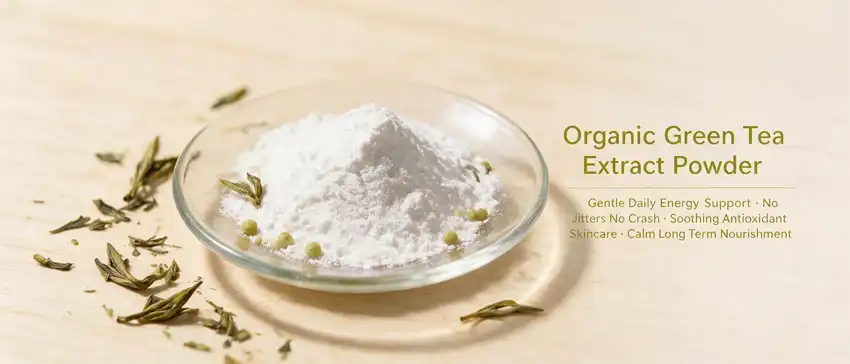
Organic green tea extract powder is obtained by extracting concentrated bioactive compounds from the unfermented leaves of Camellia sinensis cultivated under certified organic conditions. The main bioactive constituents include polyphenols, catechins, and EGCG. Certified leaves are harvested and extracted using water or food-grade ethanol, contaminants are filtered out, and the liquid concentrate is then dried into a fine, standardized powder. The outcome is a powerful, traceable ingredient with carefully measured active indicators that provides marketers a clean label option that complies with worldwide regulatory standards for dietary supplements and functional nutrition products.
Understanding Organic Green Tea Extract Powder
What Sets It Apart from Regular Green Tea Powder
Organic Green Tea Extract Powder Is Not Just Ground-Up Tea Leaves. The concentrated substance is produced by a deliberate method of extraction that isolates certain beneficial compounds. The whole leaves are used to manufacture the green tea or matcha powder you purchase in supermarkets. Organic green tea extract powder, in contrast, is standardized to a certain level of polyphenols—usually 50%–98% total polyphenols—which enables formulators to regulate exactly how much ends up in final products and how effectively they perform.
Key Bioactive Compounds and Their Benefits
EGCG is what makes green tea extract function; it is the most powerful catechin. According to the ORAC measure, research in the Journal of Nutritional Biochemistry shows that EGCG is a much superior antioxidant than Vitamin C. Good organic green tea extract powder is checked most of the time to have at least 45% EGCG by HPLC. This means that every batch of green tea extract has equal amounts.
Why Organic Certification Matters to B2B Buyers
If you’re a vitamin or nutraceutical company looking to sell in the U.S. or EU, having organic clearance may help you avoid a major risk. This kind of tea is typically denied entry at customs because it contains too many chemicals. Organic green tea extract powder, whether it has the USDA or EU seal of approval, is produced under rigorous agricultural guidelines that prohibit the use of herbicides, pesticides, and genetically modified crops. This makes it much simpler to pass regulatory inspections and maintain the clean label of a product.
Traditional vs. Modern Extraction Methods
How Traditional Processing Works
In the past, green tea leaves were only steamed, dried, and ground. The outcome was different for each batch, and there wasn't much that could be done to keep it from getting messed up. The supplement business always needs a lot of polyphenols, but these simple methods couldn't make them consistently.
Advanced Extraction Technologies in Use Today
Today, bulk green tea extract powder is mostly made in three different ways. The best and healthiest way to get catechins out of dark chocolate is to take a hot shower. Food-grade organic ethanol is used for ethanol extraction to get a wider range of flavonoids that are stronger. This method is used to remove the caffeine from coffee beans while leaving the heat-sensitive EGCG alone and not leaving any liquid behind.
By using these technologies to standardize active markers, companies can keep the whole supply chain in good shape.
Core Manufacturing Steps and Quality Controls
To make organic green tea extract powder, follow these steps:
- Raw material intake: Certified organic Camellia sinensis leaves are received, inspected, and tested for pesticide residues and heavy metals before processing begins.
- Extraction and filtration: Leaves are extracted using permitted solvents, then passed through membrane filtration to remove waxes, tannins, and insoluble fiber—this step is essential for producing cold-water-soluble grades used in RTD beverages.
- Concentration and drying: The liquid extract is concentrated under low temperatures to protect bioactives, then spray-dried or freeze-dried into the final powder form.
Green tea leaves from Camellia sinensis are received, inspected, and checked for heavy metals and chemical residues before they are used.- Extraction and filtering: Solvents that are allowed are used to get rid of wax, tannins, and fibers that don't dissolve in water from the leaves. After that, membrane filtration is used to get rid of the waste. This step is needed to make grades that can be mixed with cold water to make RTD drinks.
Key Dimensions Impacting Production Quality
Sourcing Certified Organic Raw Materials
The organic green tea extract powder is field-manufactured to ensure quality. There has to be documentation that the leaves are from farms that are USDA NOP or EU Organic Certified. When people purchase from another firm, they typically ask for a Certificate of Analysis (COA) and evidence of origin. Import regulations guarantee the quality of commodities and their monitoring.
Comparing Extraction Solvents and Their Compliance Impact
Even with organic certification, only water and organic ethanol may be used as solvents. Hexane or ethyl acetate are typically employed in traditional extraction methods. “There are organic supply chains that won’t allow them in, and these chemicals can be left behind in the environment. If you choose a firm that only utilizes organic solvents, you can keep your business secure and be certain that the product may claim it is organic without breaching the law.
Drying Technology: Spray Drying vs. Freeze Drying
The most popular method is to spray things dry. It is prepared as a smooth, fine powder with 0.40 to 0.60 g/mL bulk density. This powder may be used as a powder blender and capsule filler. Freeze-drying preserves more of the heat-sensitive compounds, but it is more expensive to create. There are a lot of things you can do with it. Freeze-dried grades of vitamins that are packed in capsules are preferable to use than spray-dried grades for functional beverages.
Evaluating Organic Green Tea Extract Powder for Your Business Needs
Interpreting Potency Metrics and Specifications
In the supplier’s data, you should search for the following three items: EGCG (≥ 45% by HPLC), Total Catechins (≥ 70% by HPLC), and Total Polyphenols (≥ 95% by UV). These tell us the usefulness of the extract. A powder that only states “green tea extract” without any standardization data is not likely to be consistent or effective. This is a huge concern for businesses that rely on getting the therapeutic dosage correct.
Powder vs. Capsule Form: What Works Best
Bulk green tea extract powder is utilized in many different goods such as skin care products, helpful beverages, pills, and tablets. Of course, it is simpler for businesses to sell capsules than powders. But OEMs and ODMs have greater control over powders, including dosage, packaging, and branding. If you are a company and purchase in quantity, then you may utilize organic green tea extract powder in many more final items. That's because you just need to purchase one thing.
Supplier Selection Criteria for Private Label Projects
If you want to purchase organic green tea extract powder, make sure you buy from a reliable source that has at least the USDA Organic, ISO 9001, and FSSC 22000 certifications. It’s also crucial to be able to create things. Whatever your demands, large or small, they should be able to provide for them, with quality still excellent. If you need to make a commercial order for many metric tons, an 8-kilogram pilot run should not be an issue in this situation. Look at third-party lab reports and get a free sample before you purchase in bulk. This will assist you in choosing a reputable source.
Practical Applications and Usage Considerations
Application Across Product Categories
There are a number of things you can do with organic green tea extract powder. Taking doses of it 200 to 500 mg a day might help you lose weight or harm cells. The variety that dissolves completely in functional drinks and leaves no lumps is termed cold-water-soluble. Research in dermatology backs up claims that the high quantity of EGCG it contains may slow down aging when used in skin care products.
Formulation Tips and Stability Considerations
This extract is stable for a while at a temperature of 80°C. Thus, it can be handled by most of the typical processing approaches. It works best in the pH range 3.0 to 6.0, which is also the pH range for making acidic beverages. The powder should be stored in fiber drums coated with food-grade polythene bags in a cool, dry environment below 25°C to prevent spoilage, and should not be wet by more than 5%. In this manner, the powder will keep fresh for 24 months.
Regulatory Compliance in the U.S. Market
So in the US, you can not sell green tea powder as a supplement unless you obey a guideline called DSHEA. The FDA has recommended that products having >800 mg of EGCG per daily dosage include appropriate label warnings. The National Toxicology Program figured this out in 2023. This means that if you work with a manufacturer that recognizes these boundaries, your brand is less likely to be regulated in the future.
Conclusion
Organic green tea extract powder needs to go through a precise series of stages before it can be utilized. It begins as an authorized organic tea field and ends up as a regular ingredient. Every stage in the manufacturing process has a direct impact on the safety, efficacy, and legality of the whole product. If supplement, nutraceutical, and OEM/ODM part producers understand how this process works, they can believe what vendors claim, verify specifications, and source with confidence. If you can identify the correct manufacturing partner, you may acquire proven quality systems, traceable raw materials, and varying levels of production.
FAQ
1. Is organic green tea extract powder the same as matcha?
No. Matcha is whole leaf powder—it contains fiber, chlorophyll, and lower concentrations of active compounds. Organic green tea extract powder is a concentrated extract standardized for specific polyphenol levels, such as 50%–98% total polyphenols. Matcha is a food ingredient; organic green tea extract powder is a functional nutraceutical ingredient designed for precise dosing in supplement and beverage applications.
2. How can I verify that an organic certification is authentic?
Request the supplier's current organic certificate with the issuing body's name (e.g., USDA NOP, ECOCERT) and expiration date. Cross-reference the certificate number against the certifying agency's public database. A credible organic green tea extract powder supplier will provide this documentation without hesitation alongside a full COA for each production batch.
3. What is the recommended storage for bulk green tea extract?
Store the powder below 25°C in a dry, dark location. Use double-sealed food-grade polyethylene inner bags inside fiber or cardboard drums. Because the powder readily absorbs moisture, avoid opening containers in humid environments. Under these conditions, organic green tea extract powder retains its antioxidant potency for up to 24 months.
4. Can the caffeine content be adjusted?
Yes. Standard organic green tea extract powder contains 5–10% naturally occurring caffeine. A decaffeinated grade (<0.5% caffeine) is available through Supercritical CO₂ processing, which removes caffeine while keeping EGCG intact.
Partner with BioSpark for Your Organic Green Tea Extract Powder Supply
They sell approved organic green tea extract powder and can help with the whole process, from making the powder to sending it to the customer. Green tea extract powder made by our company is sold to brands in North America and other places. We can get different-sized batches, and someone else has checked the quality. Go to leao@biosparkcn.com to get a sample or talk to our team about what you want to buy.
References
1. Khan, N., & Mukhtar, H. (2013). Tea and Health: Studies in Humans. Current Pharmaceutical Design, 19(34), 6141–6147.
2. Sang, S., Lambert, J. D., & Ho, C. T. (2011). The Chemistry and Biotransformation of Tea Constituents. Pharmacological Research, 64(2), 87–99.
3. National Toxicology Program. (2023). NTP Technical Report on Green Tea Extract. U.S. Department of Health and Human Services.
4. Cabrera, C., Artacho, R., & Giménez, R. (2006). Beneficial Effects of Green Tea — A Review. Journal of the American College of Nutrition, 25(2), 79–99.
5. Chow, H. H. S., & Hakim, I. A. (2011). Pharmacokinetic and Chemoprevention Studies on Tea in Humans. Pharmacological Research, 64(2), 105–112.
6. Reygaert, W. C. (2018). Green Tea Catechins: Their Use in Treating and Preventing Infectious Diseases. BioMed Research International, 2018, Article ID 9105261.

Send Inquiry
Related Industry Knowledge
- How to Choose the Best Ashwagandha Leaf Extract Supplier
- Is Liposomal Silymarin the Next Step in Liver Wellness?
- Damiana Peptide: Benefits, Uses, and Applications
- How to Choose the Best Barley Sprout Flour Supplier?
- Where to Buy Sea Buckthorn Juice Powder in Bulk Worldwide
- Why Is Marigold Extract Powder the Top Lutein Source Globally?
- Egg Yolk Fruit Powder Benefits for Health Food Products
- How Does Cape Gooseberry Powder Enhance Smoothie Taste?
- What are the top health benefits of gardenia fruit powder?
- Can gardenia fruit powder be used in skincare products?