Liposomal Calcium Citrate vs. Standard Calcium: Which Wins?
Oct 26, 2026
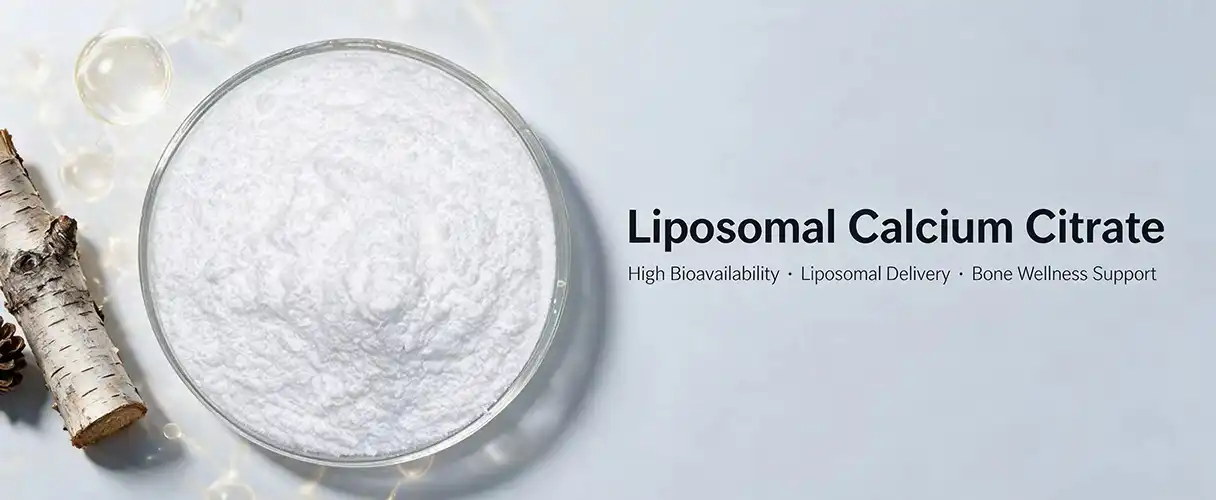
If you’re obtaining calcium compounds for supplement formulations, you’ve probably wondered: does liposomal calcium citrate work better than regular calcium, or is it merely a premium price tag? The simple answer is that liposomal calcium citrate beats the others on bioavailability and tolerability. Calcium citrate is protected throughout digestion and released more effectively in the small intestine by nano-sized vesicles containing calcium citrate. Absorption rates with liposomal administration may be above 95%, and about 30-35% for normal calcium carbonate. That distinction is important to firms that are making high-performance bone health or pregnancy formulations.
Understanding Calcium Citrate and Liposomal Calcium Citrate
What Is Standard Calcium Citrate?
Normal calcium citrate is made up of calcium and citric acid. Too little stomach acid will not break down calcium carbonate. People over 65 or who don't have enough stomach acid should choose this. It works pretty well, and calcium makes up about 21% of its weight. Still, the digestive system has a hard time breaking it down, especially when it comes across oxalates and phytates, which are found in food.
What Makes the Liposomal Form Different?
The phospholipid bilayer packaging used by liposomal calcium citrate keeps calcium ions in a place that is good for water. This is the same type of membrane structure that is found in human cells. The pieces that make up this nano-coating are between 80 and 150 nm wide. They make sure that the calcium doesn't break down before it can be taken in. Calcium goes straight into the bloodstream when the liposome binds to the cell walls of the gut. A lot of the things that can't happen with other methods can happen with this one.
Why Bioavailability Matters for Manufacturers
For OEM and ODM goods, an ingredient that is better absorbed means that the doses are smaller, the capsules are smaller, and the label makes more claims about how well it works. A lot of thought goes into the delivery method when high-end bone health vitamins, prenatal nutrition items, or clinical nutrition lines are being made. It tells you where the product stands in the market and how valuable people think it is.
Comparing Effectiveness and Benefits for Bone Health
Absorption Efficiency: A Clear Gap
Some studies, like the one in Osteoporosis International, back up the claim that lipid-encapsulated calcium formulations are better at being absorbed by the gut than regular calcium salts. Calcium carbonate doesn't absorb as well as calcium citrate does, but liposomal technology makes it even better. To do this, it keeps calcium ions safe in the stomach's acid and lets them out at the wall of the intestine, which is where absorption takes place most.
Dosage and Safety Profile for Product Development
It is possible to meet treatment goals with less elemental calcium because each capsule dose has more calcium. This keeps you from getting too much calcium when you eat a lot. It is better for your digestive system to take calcium citrate in liposomal form instead of calcium carbonate. It doesn't make you bloated and unable to go to the bathroom as calcium carbonate does. This works well for business-to-business clients who want to reach sensitive groups like kids, pregnant women, or adults who have gone through menopause.
Bone Health Outcomes and Market Applications
Getting enough calcium is a direct way to keep your bone mineral density high and keep it from breaking. Bone tissue is mostly made up of calcium. Giving calcium citrate in liposomes can help stop osteoporosis, make sports nutrition better (for example, to help muscles heal from stress fractures), and make nutrition better after giving birth. There is a lot of room for growth in the U.S. market for these types of supplements, so choosing ingredients is a clear business choice.
Market Comparison and Procurement Considerations
Calcium Forms Side by Side
There are different kinds of calcium tablets that you can buy. Check out how these two items stack up:
- Calcium carbonate carries the highest elemental calcium content (40%) but requires stomach acid and frequently causes digestive discomfort. It suits low-cost, mass-market products.
- Standard calcium citrate is better tolerated, absorbs without acid dependency, and works well for mid-tier supplement lines. Procurement costs are moderate.
- Chelated calcium (e.g., calcium glycinate) shows improved absorption but carries a higher ingredient cost and is less widely manufactured.
- Liposomal calcium citrate commands the highest ingredient cost but delivers measurably superior bioavailability and gastrointestinal tolerance — the right fit for premium, clinician-recommended, or specialty nutrition lines.
It depends on who you want to buy your product, how you plan to set your earnings, and how you plan to explain how your product works.
Pricing Tiers and MOQ Realities
To make liposomal calcium citrate, you have to go through more steps than when you just make calcium salts. These steps include active drug loading, particle size homogenization, cross-flow ultrafiltration, and clean filtration. Even so, many sellers offer different deals based on how much is bought, and as technology for making things has improved, it has become easier to meet MOQs for liposomal types. People in charge of buying should ask sellers for price breaks at different levels of volume before they agree to a deal.
Supplier Quality and Compliance Standards
If you want to buy liposomal calcium citrate, don't just look at the price per unit. Getting a heavy metal and microbe testing report from a third party, making sure the encapsulation rate is higher than 95% (this can be done with active drug loading methods), checking the particle size with dynamic light scattering (DLS), and getting Zeta potential data to make sure the product is stable are all important checks. It is against the rules to make food that doesn't have an ISO, GMP, or HACCP label on it. You should be able to see on the Certificates of Analysis (CoA) how much basic calcium, pH, peroxide value, and bacterial toxins are present.
How Liposomal Calcium Citrate Works: Technical and Practical Insights
The Science of Liposomal Delivery
Liposomes are made up of cholesterol, phosphatidylcholine, and phospholipids that have been modified with PEG. The shape looks like a bubble. People who make liposomal calcium citrate often use a calcium ion concentration gradient to put drugs in a way that makes them work. Some liposomes are washed with a medium that doesn't have any calcium in it. The liposomes don't have any calcium inside them. Because citrate ions move inside and settle on the calcium, more than 95% of it stays inside the vesicle.
Dosage Forms and Formulation Integration
Liposomal calcium citrate comes in a number of different dose forms. It's easy to mix the freeze-dried powder back together to put in pills or capsules. For single-dose oral presentations that come in liquid form, it can be ready to drink or in the form of drops. It is possible to make pills smooth with the right fillers, but the fatty matrix needs a binding that has been carefully picked. Teams in charge of making things need to test ingredients that were mixed together to see how well they work. These steps are very important for vitamins that dissolve in fat, like D3 and K2, which are often mixed with calcium in bone health products.
Storage, Handling, and Supply Chain Notes
The things that light and warmth do to liposomes more often than they do to calcium salts. It is easier to ship things to other countries when you use freeze-dried formats because they make shelves more stable and let you store things at room temperature. What you pack needs to protect against UV light and wetness whether you send a lot of things away by ocean freight or quickly by air freight. Even more proof that the product is real comes from suppliers who offer cold-chain options and packaging that has been flushed with nitrogen.
Final Procurement Recommendations: Which Should You Choose?
Matching the Ingredient to Your Product Strategy
Calcium citrate is still used in many everyday supplement brands because it is cheap and easy to handle. It works well in cheap bone health items that are made for everyone. If you want your business to be seen as high-end, if you want to reach sensitive people, or if you want to sell in a market that values claims of high absorption and clinical reliability, liposomal calcium citrate is the best option.
ROI Considerations for OEM Buyers
It costs more for the chemicals to be in liposomal form, but you can buy it in high-end stores, online, and from practitioners, so it works out. It will sell for more and keep people coming back if it uses absorption technology that has been tried and tested and shown to work. When OEM clients want to make private label lines that stand out, price is often more important than quality.
Why BioSpark Is the Right Manufacturing Partner
Liposomal calcium citrate is made by BioSpark (Xi'an) Biotechnology Co., Ltd. under strict GMP rules. To make sure the quality is good, they check for endotoxin, particle size, pill rate, calcium content, and cleanliness. We can make a lot of things for companies or just a few to try out. We're open to trade, and we ship anywhere in the world by air, sea, or fast service. From the moment you have an idea until the project is finished, we can help you. It doesn't matter if you need a finished recipe or just the right mix of items.
Conclusion
Simple calcium citrate is a good chemical that is easy to find. Liposomal calcium citrate, on the other hand, is better for high-end vitamin brands because it is easier to work with and better absorbed. The liposomal form should be used by people who are in charge of buying things and OEM partners who are making products that need to stand out in crowded markets, like those for bone health, sports nutrition, or prenatal care. Which one you pick will rely on how you sell your business and the clients you have.

FAQ
Is liposomal calcium citrate safe for long-term use?
Yes. The phospholipid bilayer used in liposomal encapsulation is composed of materials naturally found in cell membranes, making it well tolerated. At recommended dosages, calcium citrate in liposomal form shows no adverse effects in healthy adults and is considered appropriate for long-term supplementation under standard dietary guidance.
What dosage forms is liposomal calcium citrate available in?
It is available as freeze-dried powder for capsules, sachets, or tablets, and as a liquid in nitrogen-filled single-dose oral formats. The freeze-dried powder format supports ambient storage and is compatible with most standard encapsulation and blending equipment.
How does encapsulation rate affect product quality?
A higher encapsulation rate — ideally above 95% — means that more of the calcium in your formula exists inside the liposome, not as free ions. Free calcium can cause precipitation, off-taste, and reduced bioavailability. Always request CoA data confirming encapsulation efficiency before purchasing.
Can small brands access liposomal calcium citrate in lower quantities?
Yes. Many manufacturers, including BioSpark, offer flexible minimum order quantities to accommodate product development and small-batch launches. Contact leao@biosparkcn.com to discuss your volume needs and production timeline.
Partner With BioSpark for Your Next Calcium Formula
BioSpark sells liposomal calcium citrate to brand names of supplements and nutrition products, as well as to OEM partners in North America and around the world. We can reliably make liposomal calcium citrate, and we offer full-process scientific support. In other words, we can help you get better goods to market more quickly. Visit https://www.biosparkcn.com/ or email leao@biosparkcn.com to get samples, specs, or help on how to make a unique mix.
References
1. Straub, D.A. (2007). Calcium supplementation in clinical practice: A review of forms, doses, and indications. Nutrition in Clinical Practice, 22(3), 286–296.
2. Heaney, R.P., Dowell, M.S., Bierman, J., Hale, C.A., & Bendich, A. (2001). Absorbability and cost-effectiveness in calcium supplementation. Journal of the American College of Nutrition, 20(3), 239–246.
3. Weaver, C.M., & Heaney, R.P. (2006). Calcium in human health. Nutrition Reviews, 64(S2), S25–S27.
4. Allen, T.M., & Cullis, P.R. (2013). Liposomal drug delivery systems: From concept to clinical applications. Advanced Drug Delivery Reviews, 65(1), 36–48.
5. Rizzoli, R., Boonen, S., Brandi, M.L., Bruyère, O., Cooper, C., Kanis, J.A., & Reginster, J.Y. (2013). Vitamin D supplementation in elderly or postmenopausal women. Osteoporosis International, 24(4), 1271–1280.
6. NIH Office of Dietary Supplements. (2022). Calcium: Fact sheet for health professionals. National Institutes of Health, U.S. Department of Health and Human Services.

Send Inquiry
Related Industry Knowledge
- How to Choose a High-Quality Bovine Spleen Peptide?
- Sea Buckthorn Juice Powder Benefits for Functional Beverage Brands
- How to Choose the Best Sea Buckthorn Juice Powder Supplier
- Coconut Milk Extract Powder: The Ultimate Plant-Based Dairy Swap
- Coconut Milk Extract Powder: The Ultimate Plant-Based Dairy Swap
- Coconut Milk Extract Powder: The Ultimate Plant-Based Dairy Swap
- Coconut Milk Extract Powder: The Ultimate Plant-Based Dairy Swap
- Coconut Milk Extract Powder: The Ultimate Plant-Based Dairy Swap
- Coconut Milk Extract Powder: The Ultimate Plant-Based Dairy Swap
- Coconut Milk Extract Powder: The Ultimate Plant-Based Dairy Swap
- Coconut Milk Extract Powder: The Ultimate Plant-Based Dairy Swap
- Coconut Milk Extract Powder: The Ultimate Plant-Based Dairy Swap
- What are the key functional benefits of pomegranate peel extract powder?
- Baicalin Extract Benefits: Is It a Powerful Natural Antioxidant?
- Is Mimosa Root Bark Extract a Sustainable Ingredient?
- Can Pomegranate Peel Extract Powder Support Weight Management?
- Maca Extract Powder for Cognitive and Mood Benefits
- How Does Pure Corn Extract Powder Support Antioxidant Defense?