_1764041963888.webp)
Snow Lotus Fruit Powder vs. Extract: Which Is Better?
Aug 20, 2026
When sourcing yacon-derived ingredients, many procurement managers wonder whether Snow lotus fruit powder or concentrated extracts provide better value for their formulations. It's easy: snow lotus fruit powder is better for business-to-business uses and costs less. This pick is lightly processed, so it keeps the natural balance of good chemicals and is still very easy to melt and mix. It has 40–60% fructooligosaccharides (FOS) amounts. There is no need for stabilizers in powder forms, which makes them easier to work with. They're easy to add to a lot of different things, from functional drinks to baked goods that are good for diabetics, and they stay fixed for 24 months.
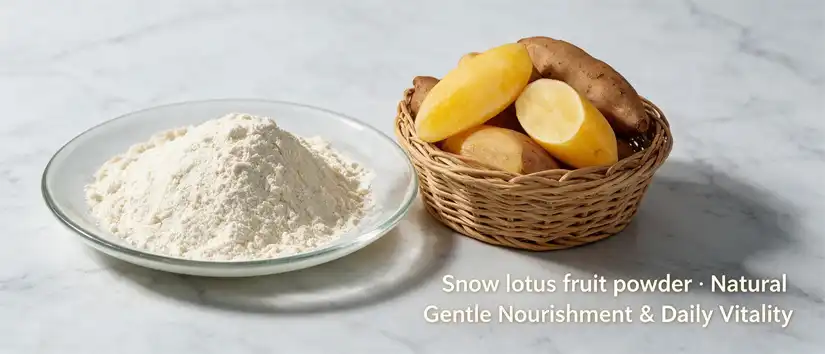
Key Comparison Dimensions Between Snow Lotus Fruit Powder and Extract
When making procurement choices, you need to look at more than just FOS numbers. We have found important comparison points that will have a direct effect on how well your product does in the market.
Active Ingredient Profiles and Potency
Snow lotus fruit powder that is standardized to 40–60% FOS has enough prebiotic action for dosing based on evidence. According to clinical research, consuming 3 to 8 grams of yacon FOS every day helps good bacteria grow without making your stomach hurt. There are 1.2 to 2.4 grams of active prebiotics in a normal 3-gram amount of 40% FOS powder, which is well within the therapeutic range.
It might look like higher-concentration extracts would be better, but they do not really make things better. FOS can only be absorbed by humans up to a certain point. Going over 10 grams a day can lead to bloating and other fluid effects. So, using 70% extracts instead of 40% powder does not give you better results; it just means changing the amount you take. Cost-wise, this change in concentration does not usually make the expense worth it for most uses.
Solubility and Formulation Integration
Functional ingredients and formulation headaches are separated by how well they dissolve in water. Yacon powder dissolves very well in cold water; after two to three minutes of gentle stirring, over 95% of the particles are gone. When making instant drink mixes or ready-to-drink mixes where hot processing is not an option, this property comes in very handy. The 80-mesh particle standard makes sure that the taste is smooth and there is no gritty residue, which is often found to be unpleasant by consumers.
Extracts might have slightly faster dissolution rates, but this benefit is not as big in real-life manufacturing, where mixing equipment does a good job of stirring things up. Also, because ultra-concentrated extracts are hygroscopic, they can clump together in powder mixes if they are not properly enclosed. This can make your supply chain more expensive and complicated.
Certification Standards and Quality Assurance
Reliable sellers keep a full set of certifications that prove the safety of their ingredients and the way they make their products. Getting ISO9001 approval shows that you handle quality in a planned way throughout all of your production processes. Good Manufacturing Practices (GMP) compliance makes sure that cleanliness standards for pharmaceuticals are met, which stops contamination. Kosher and Halal certifications make it easier for businesses to reach religiously strict customers, while FDA registration makes sure that facilities follow U.S. rules.
When judging suppliers, pay close attention to what their certifications cover. Some makers have licenses for their building but not for certain lines of products. Some people may show old documents. To avoid quality surprises after shipment, make sure you ask for up-to-date certificates with batch-specific Certificates of Analysis (CoA). Each batch should come with a thin-layer chromatography report that confirms the FOS content meets the requirements.
Shelf Life and Storage Requirements
Powder mixtures usually last for 24 months if they are kept below 25°C in containers that are sealed and will not let moisture in. The low moisture level (less than 4%) stops the growth of microbes and enzymes that break down food. Using nitrogen-flushed packaging with desiccant packets makes things even more stable by keeping them from oxidizing and getting wet.
It is harder to keep liquid solutions stable. They may need to be refrigerated after being opened and have a shorter shelf life than powder formats. If the storage conditions change, the water activity in liquid forms can lead to fermentation. For business-to-business buyers who are in charge of managing inventory across multiple stores or foreign delivery networks, powder formats make handling a lot easier and cut down on waste from old stock.
Procurement Insights: Making an Informed Purchase Decision
To find yacon ingredients around the world, you need to know how the markets work and how they affect prices, availability, and quality. Working with international procurement teams has taught us about common mistakes and strategic chances.
Supplier Landscape and Geographic Considerations
China has become a major maker of standardized Snow lotus fruit powder by using its farming resources and improved extraction techniques. Manufacturers in Shaanxi Province can easily get plant materials and the framework for biotech is already in place. Because of this regional clustering, prices can be kept low without lowering quality standards. The cost of making things in this area is usually 20–30% less than in Europe or North America, but the level of approval is still the same.
Check the export history of Chinese sellers when you are rating them. Companies that have established distribution networks in the US show that they know the FDA's rules for importing goods and how to properly document them. Buyers with different levels of experience with imports can find suppliers who offer flexible delivery terms, such as FOB, CIF, CFR, EXW, DAP, and DDP. This level of adaptability is very important for keeping track of landing costs and customs processes.
Bulk Pricing and Volume Considerations
Minimum order numbers (MOQ) have a big effect on the total cost of acquisition. Progressive sellers have low MOQs—as little as 1 kilogram for testing purposes—so that customers can get a good feel for the product before committing to large orders. Standard bulk packaging comes in 25-kilogram drums, which are easy to handle and the right weight for shipping.
Tiered structures are often used for volume pricing. Standard prices are used for orders below 100 kilograms. 8–12% discounts are common for commitments over 500 kilograms, and 15–20% savings can be found for annual framework contracts for multiple tons. These savings add up quickly for companies that make a steady stream of products instead of just a few seasonal ones.
Logistics and Delivery Timelines
Standard lead times for stock items are about 10 business days, which includes processing the order, checking the quality, and getting ready to ship. Custom formulations that need specific FOS concentrations or changes to particle size make the lead time 30 days. Knowing these dates helps make sure that purchasing and production schedules are in sync, which avoids costly delays in production.
When choosing a shipping method, you have to weigh speed against cost. Express delivery services can deliver within 5 to 7 days, but they charge a lot of money and are only good for small, pressing orders. Costs are much lower with air freight, and deliveries are guaranteed within 10 to 12 days, which is perfect for orders weighing 25 to 200 kilograms. For large amounts, sea freight is the most cost-effective option, but the 30- to 45-day travel times mean that you need to plan ahead and keep enough safety stock on hand.
Total Cost of Ownership Analysis
Smart buying looks at costs other than the price per kilogram. Think about how well the formulation works: if 5 grams of powder have the same effect as 3.5 grams of extract but cost 40% less per kilogram, the powder is the better deal. Also think about the costs of processing; powders that dissolve fully get rid of the need for filtering steps in some extracts.
Businesses that do not have a lot of storage space need to think about storage costs. Powder has a long shelf life and can be stored at room temperature, which cuts down on the cost of cooling and waste from expiration. Figure out how much it costs to keep an inventory based on how often items are sold and how they need to be stored.
How to Choose the Right Snow Lotus Fruit Product for Your Business
Matching the specs of the ingredients to the needs of your application guarantees the best product performance and customer happiness. We have made a framework that makes choice factors clear across a range of industries.
Application-Specific Requirements
Solubility and flavor neutrality are important to people who make functional drinks. The mild sweetness of Snow lotus fruit powder goes well with fruit flavors and does not add any unwanted flavors like some prebiotic fibers do. The fine 80-mesh particle size keeps the color from settling in bottled drinks, so they look good for a long time. For fizzy drinks, make sure the powder will not cause too much foam to form during the filling process.
Volume and Customization Needs
Supplement companies that make pills or tablets need high-speed packaging tools that can flow the ingredients easily. Powder with a fixed moisture level below 4% keeps hoppers from bridging and makes sure that fill weights stay the same. The natural FOS content gets rid of the need for multiple ingredients, which makes labels easier to read for health-conscious consumers.
The synbiotic features of yacon help dairy companies make prebiotic yogurts or kefirs. The FOS feeds only the types of Lactobacillus and Bifidobacterium that are widely found in fermented foods. This helps the probiotics stay alive while they are stored in the fridge. Some prebiotics can change the stability of milk proteins, but yacon powder keeps the texture of the product the same across normal yogurt pH ranges (4.0–4.5).
Regulatory Compliance and Documentation
Suppliers with flexible minimum orders are good for small businesses and new businesses. During the product development stages, having the option to buy 1-kilogram samples for prototype development lowers the risk of losing money. Moving to 25-kilogram drums or bigger amounts is easy once recipes are proven to work, as suppliers are good at handling both sizes.
Having OEM and ODM skills gives you a lot more choices. Suppliers with their own research and development departments can change the amount of FOS by 40 to 60% to meet specific prebiotic treatment goals. They can also make synbiotic blends by mixing yacon FOS with probiotic strains that work well together, like Lactobacillus rhamnosus, Bifidobacterium lactis, or Saccharomyces boulardii. This makes ready-to-use formulations that cut down on the time it takes to get your product to market.
Enhancing Product Offering: Practical Applications and Usage Protocols
To get the most out of Snow lotus fruit powder's versatility, you need to know how to use it in a way that keeps its functionality while giving the product the qualities you want. These useful tips come from formulating things in the real world across many businesses.
Functional Beverage Formulation
Yacon dissolves easily in cold water, which is good for prebiotic drink mixes. Start with a rate of 3 to 5 percent in powdered drink bases. When you mix yacon with fibers that work well together, like inulin or partly hydrolyzed guar gum, the benefits of feeling full will be stronger. The light sweetness means that you do not need to add as many sweeteners, which makes clean-label recipes easier.
To keep heat-sensitive FOS in ready-to-drink drinks, add yacon during the blending step after pasteurization. Using citric acid or natural fruit acids, raise the pH to 3.5 to 4.5. This range makes FOS more stable while still giving the drink its typical tartness. Some protein sources may react with oligosaccharides while they are being stored, so it is important to test drinks with protein carefully, like prebiotic protein shakes. Do rapid shelf-life studies (40°C for two weeks) to find problems before they happen in mass production.
Supplement Integration Strategies
Most capsules contain 300 to 500 milligrams of yacon powder, and it is recommended to take two to three capsules twice a day to reach the optimal range of 3 to 8 grams per day. Mix yacon with flow aids like silicon dioxide (0.5–1%) to make sure uniform sealing at speeds of more than 100,000 capsules per hour. Vegetarian capsules (HPMC) work great with yacon, but gelatin capsules can still be used for products that need to be cheap.
For tablets to be sufficiently hard without becoming too fragile when compressed, binding agents are needed. At 10-15%, microcrystalline cellulose gives enough structure while still breaking down quickly (under 30 minutes in USP dissolution testing). As a lubricant, magnesium stearate (0.5–1%) keeps things from sticking when they are compressed. A tablet's toughness should be between 8 and 12 kiloponds so that it is easy for people to handle without breaking.
Dairy and Fermented Food Enhancement
Before fermentation, yogurt makers can add yacon to the milk base at a rate of 1% to 2%. The FOS helps the probiotics grow without changing the process of culture. Some makers add yacon after fermentation to boost the prebiotics. This works well, but it does not have the synbiotic benefits of cultures fed FOS.
People who make kefir and kombucha find yacon very useful because the fructooligosaccharides feed both bacteria and good yeasts. This all-around help makes fermented flavors more complex and increases the number of probiotics in the body. For the best results, add yacon to the original fermentation base at a rate of 0.5 to 1%.
Dosage Guidelines and Safety Protocols
Based on clinical data, eating 3 to 8 grams of prebiotics every day can help your health without making your stomach hurt. Starting people on the lower end (3 grams) for the first week lets the gut bacteria adapt, which lowers the gas that can happen when prebiotics are suddenly increased. A gradualincrease to 5 to 8 grams gets the most benefits with the least amount of side effects.
Sensitive people, like those with irritable bowel syndrome or small intestinal bacterial overgrowth (SIBO), may need to start with even less, at 1-2 grams per day. On the product label, there should be usage directions that mention this time for adjustment, so that customers know what to expect.
Conclusion
The choice between powder and extract comes down to your specific formulation needs, budget, and position in the market. Snow lotus fruit powder is very useful for making functional drinks, supplements, foods that are good for diabetics, and fermented foods. It is also very cheap, which is something that extracts rarely do. The 40–60% FOS concentration gives prebiotic action that is therapeutically useful without over-processing, which breaks down other phytonutrients. Powder is the practical choice for most B2B uses because it dissolves better, stays stable for longer, and is easier to ship. Your products will do well in the market if you work with certified suppliers who keep strict quality controls, offer flexible ordering terms, and offer full technical support.

FAQ
Can powder and extract be used interchangeably in formulations?
When substituting Snow lotus fruit powder, the dose needs to be changed based on the different FOS concentrations. If you're switching from a 40% powder to a 60% extract, cut the amount you use in half to keep the same prebiotic dose. Reformulation testing is still needed because the way an ingredient dissolves, how sweet it is, and how it reacts with other ingredients can change. Some producers find that the extra phytonutrients in powder add subtle taste notes that pure extracts do not have, so they have to make some small changes to their flavor systems.
How do organic certifications affect product quality and pricing?
Organic approval confirms that farming methods are good, but it does not automatically mean that the food has more FOS or better prebiotic effects. Quality is mostly determined by how the product is extracted and how it is made, not by how it was grown. Still, organic products cost 15–25% more in stores, so brands that want to attract people who like natural goods should get approval. The price of buying certified organic yacon powder goes up by 30 to 40 percent compared to regular yacon powder.
What are potential side effects or contraindications?
Yacon has been shown to be very safe in clinical tests. When starting a new supplement, digestive adaptation can cause temporary gas. This usually goes away in 5 to 7 days. People who have trouble absorbing fructose should talk to their doctors before using products that are high in fructose. No major drug reactions have been reported, but diabetics should keep an eye on their blood sugar when they first start eating yacon because its low GI may allow them to change their medications with their doctor's approval.
Partner with BioSpark: Your Trusted Snow Lotus Fruit Powder Supplier
BioSpark (Xi'an) Biotechnology Co., Ltd. makes high-quality yacon ingredients that meet the strict requirements of functional food and supplement brands around the world. Our high-tech low-temperature extraction method keeps the highest amount of FOS while preserving the natural compound synergy that makes yacon really useful. We meet the rules in all places around the world because we have ISO9001, GMP, FDA registration, and Kosher and Halal approvals. Our flexible approach works for both new brands that need trial quantities of 1 kilogram and well-known companies that need annual supply agreements for multiple tons. The expert team offers a wide range of services, such as formulation advice, stability testing, and help with regulatory paperwork, to make sure your goods get to market quickly. Email our purchasing agents at leao@biosparkcn.com to talk about your unique needs and get full technical specifications along with reasonable prices for high-quality Snow lotus fruit powder.
References
1. Gibson, G.R., et al. (2017). Expert consensus document: The International Scientific Association for Probiotics and Prebiotics (ISAPP) consensus statement on the definition and scope of prebiotics. Nature Reviews Gastroenterology & Hepatology, 14(8), 491-502.
2. Delgado, G.T., et al. (2012). Yacon (Smallanthus sonchifolius): A functional food. Plant Foods for Human Nutrition, 68(3), 222-228.
3. Geyer, M., et al. (2008). Effect of yacon (Smallanthus sonchifolius) on colonic transit time in healthy volunteers. Digestion, 78(1), 30-33.
4. Scheid, M.M., et al. (2014). Yacon syrup in patients with prediabetes or diabetes: A randomized clinical trial. Clinical Nutrition, 33(5), 771-777.
5. Campos, D., et al. (2012). Prebiotic effects of yacon (Smallanthus sonchifolius Poepp. & Endl), a source of fructooligosaccharides and phenolic compounds with antioxidant activity. Food Chemistry, 135(3), 1592-1599.
6. Roberfroid, M., et al. (2010). Prebiotic effects: Metabolic and health benefits. British Journal of Nutrition, 104(S2), S1-S63.

Send Inquiry

Related Industry Knowledge
- Gardenia fruit powder vs. extract: Which Is Better for Your Needs?
- What is Holy Berry powder used for in Herbal Supplements?
- Maqui Berry Powder for Eye Health: Dry Eye & Retinal Protection
- Maqui Berry Powder for Eye Health: Dry Eye & Retinal Protection
- Maqui Berry Powder for Eye Health: Dry Eye & Retinal Protection
- Maqui Berry Powder for Eye Health: Dry Eye & Retinal Protection
- Maqui Berry Powder for Eye Health: Dry Eye & Retinal Protection
- Maqui Berry Powder for Eye Health: Dry Eye & Retinal Protection
- Maqui Berry Powder for Eye Health: Dry Eye & Retinal Protection
- Maqui Berry Powder for Eye Health: Dry Eye & Retinal Protection
- Maqui Berry Powder for Eye Health: Dry Eye & Retinal Protection
- Maqui Berry Powder for Eye Health: Dry Eye & Retinal Protection
- What makes nature artichoke extract a premium herbal supplement?
- American Ginseng Extract Powder for Nootropic and Brain Health Formulas
- Why Choose Natural Blueberry Extract Powder for Supplements?
- Can Baicalin Extract Enhance Overall Cellular Health?
- Can Miltiorrhiza Root Extract Powder Aid Aging Support?
- Can Yacon Root Extract Help Support Blood Sugar Control?
- Ghanaian Seed Extract Applications in Pharma & Nutraceutical Markets