What Makes Bovine Spleen Peptide a Popular Wellness Ingredient?
Nov 19, 2026
Because it comes from an organ and works well in powders, capsules, and functional blends, bovine spleen peptide is liked by many brands. It is made by using water to break down cow spleen tissue into small pieces of peptides. It may be easier to dissolve and work with these pieces than with whole tissue. It also meets the needs of shoppers who want specific products for immune health and daily nutrition. But just because something is popular doesn't mean it works in the real world. That's why I split this guide into sections for traditional use, lab research, and human evidence. I also talk about U.S. laws, quality checks, and the steps that supplement brands, distributors, and OEM buyers need to take to find suppliers.
What Is Bovine Spleen Peptide?
How Bovine Spleen Peptide Is Produced
It is obtained from the spleen tissue of buffaloes or cows. After cleaning up the tissue, certain enzymes are utilised to break up lengthy proteins into shorter peptide chains. It is hydrolysed, then filtered, condensed, and dried to a powder. At the conclusion of each stage, the profile changes. The temperature, reaction time or filtration may modify the size, flavour or solubility of peptides. This is why two products with the same name may not combine well in a recipe. If someone wants to purchase anything, they should enquire not just what it’s named, but how it operates. How the provider explains the process is a good indication of how much attention they pay to the crucial elements.
Specifications Buyers Should Check
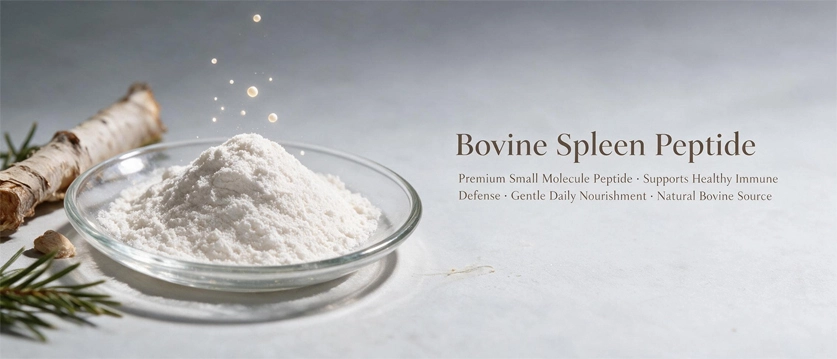
A good powder should be white to off-white, contain at least 90% protein by dry weight, at least 80% peptides, and no more than 6.0% ash. This kind of powder has a technical sheet that you can see here. Some sheets also say that more than 99% of peptides can dissolve in water and that 85–90% of them are between 150 and 1,000 Daltons. You shouldn't take these numbers as promises, but as goals that you need to reach. The batch's proof of analysis (COA) should show the real result and the test method, such as OPA or GPC for peptide content. Find out about moisture, microbiology, and heavy metals as well. This powder likes to soak up water, so how you store it is important.
Peptide, Extract, and Glandular Products Are Not the Same
There are often gland supplements, whole spleen extract supplements, and bovine spleen peptide supplements next to each other on the same list. They're not the same. Pepsin powder already has broken down protein into smaller chains because it has been hydrolyzed. Most of the time, this makes it easier to mix and dissolve. This is possible: whole extracts and glandular products might keep more of the structure of the original tissue. They might also work in different ways in drinks or capsules. They also taste, cost, and have different labels. Before you compare prices, I think you should make sure that the form, protein level, and peptide size distribution are all the same. You might not be getting as many peptides if the price per kilogram is lower. This would change the real cost per serving.
Why Is Bovine Spleen Peptide a Popular Wellness Ingredient?
Organ-Based Nutrition in a Peptide Format
Organs are good for people who want to get nutrition from whole animals. Spleen tissue is known to have iron, vitamin B12, amino acids, and other things in it. Trace minerals like zinc and selenium are also said to be present by technical sources. Rates are different for each item. It is also easier to dissolve smaller peptides when they are broken down by water. This means that bovine spleen peptide can be put into capsules, drink powders, and sachets. It has also been looked at how the intestinal transporter PepT1 moves di- and tripeptides across the gut wall. Even though that study doesn't prove that this ingredient works, it does show why small peptides are interesting.
The Evidence Behind Bovine Spleen Peptide
Most of the claims about bovine spleen peptide come from studies that have been done on animals and in labs. In immune system models, peptides from the spleen have been looked at in terms of lymphocyte activity and cytokine signaling. People don't seem to be used in large, well-controlled tests on finished goods that happen very often. When brands write about this, I tell them to be honest. FDA structure/function rules say that even words like "supports immune health" must be backed up by proof. Do not use words that imply they can treat illness, digestive issues, or the harm caused by alcohol. If you write honest copy, people who know what they're reading will trust your brand.
Market Positioning for Brands
Brands use bovine spleen peptide to stand out on immune and daily wellness shelves that are already very crowded. A lot of well-known ingredients that help the immune system are vitamins and plants. What about an organ-based peptide? It has a different story to tell and can be mixed with them in a formula with more than one ingredient. It will help adults who want targeted nutrition as well as active people who already buy peptide products. People who sell things can benefit because one powder can be used to make many different types of finished goods. Still, positioning has to follow the rules, requirements, and proof for labeling in the US. A clear, modest claim backed by proof usually holds up better over time than a bold claim you can't back up.
Bovine Spleen Peptide Uses and Ingredient Comparisons
Using Bovine Spleen Peptide in Supplements and Functional Products
Bovine spleen peptide is utilised in the formulation of peptide complexes, organ-based nutrition products, immune-support blends and daily wellness powders. It works effectively with vitamins, minerals, plant extracts, and other glandulars and extracts. There are plenty of products that come in packaging including stick packs, sachets, pills and hard shell capsules. A stick pack is great for powder that dissolves easily. A capsule, however, conceals tastes and scents. Each format has to be looked at, for example, the way the powder flows while it is being filled, or the way the tablets behave when they are squeezed together. Deciding on the format early saves time since it helps you define the demands and restrict the range of vendors that can satisfy them.
Formulation Checks Before Production
I think you should do a quick test run on the bench before the commercials. Check to see if the peptide powder can mix with water in the amount that was planned for each serving. Also, write down what it smells and tastes like, because peptide powders can have a strong taste that needs to be hidden. If something takes in water, it can clump together and slow down capsule machines. Check the hygroscopicity. Keep an eye out to see if it works with other ingredients, like minerals, that could change the style or taste. As the last step, check to see if the final packaging is stable. It won't cost you much to do these steps, and they give you real data for your quality file if a full batch fails.
Comparing Bovine Spleen Peptide With Other Options
There is bovine spleen peptide and another choice. Peptides usually give you more control over how they break down and how their sizes are spread out than glandular powder or whole spleen extract. However, glandular products may still have more of the raw organ material in them. Bovine liver peptide is not a direct replacement because it is not the same in terms of nutrition and the people it is meant for. When it comes to format, finished capsules are easier to take and give you more control over your senses, while bulk powder lets you control your dose more and costs less to package in large amounts. If you want to compare things other than names, use test data like how much protein or peptide is present and how well it dissolves. Two things that have the same label might not be the same at all.
Quality, Safety, and U.S. Compliance
Traceability and Batch Testing
To start with quality, you need to be able to trace the food from where the animals got it to where it was used. Find out about the animal's species, where it came from, where it was processed, and how it was checked for health risks. Then read the COA very carefully. A useful COA has the lot number, the date it was made, the test methods, the lab, and the limits for the amount of moisture, ash, microbiology, heavy metals, and protein and peptides. Check that all the COAs from different lots are the same before you approve long-term supply. Certifications such as GMP, HACCP, ISO, Halal, or Kosher may be important for some products. There is more than just a logo on a brochure that you should ask for.
Dosage and Safety of Bovine Spleen Peptide
Bovine spleen peptide cannot be administered in a single dosage. With the help of a qualified formulator and a regulatory specialist, you can decide how much to serve. The answer will depend on the amount of peptide, the molecular weight profile, the format of the product, and the proof you can give. If you want to make sure everyone is safe, go over the rules for animal origin, storage, and handling. A few people may have mild digestive issues, such as being sick or having loose stools. You should talk to a doctor or nurse before using it if you have health problems, take medicine, are pregnant, or are nursing. Writing clear directions and any warnings that the law requires should go on the label.
U.S. Regulatory Points
In the US, it's known as the Dietary Supplement Health and Education Act of 1994. This is the FDA's good manufacturing practice rule right now: 21 CFR Part 111. It's what manufacturers have to do. Claims about structure or function must be backed up by evidence, and the FDA must be told within 30 days of marketing. There must also be the usual disclaimer that the FDA has not evaluated the statement. If someone wants to import something, they should find out if they need to pay Foreign Supplier Verification Program duties. Take a look at the FDA's rules on using cow parts in food and the USDA's APHIS rules on bringing food in from countries with BSE issues. This ingredient comes from cattle. Companies can't say they can find disease, treat it, cure it, or stop it.
Choosing a Supplier and Planning Your Purchase
How to Choose a Bovine Spleen Peptide Supplier
The way you run your business will help you pick the right supplier. A lot of the time, supplement brands look at private-label services, documentation, and help with formulation. Distributors look at the size of the product, how well it has been exported before, and the packaging options. People who buy from OEMs can come to us when they need custom formulas, capsule filling, sachet production, or labeling. Find out about certifications, minimum order quantities (MOQs), lead times, prices for different volumes, and ask for samples and more information. Some red flags are unclear peptide content, generic certificates, medical claims that can't be backed up, and prices that are too low to make sense. It's likely that a supplier's business is run well if they clear up these questions.
A Practical Buying Workflow
When the process is clear, there is less technical and legal risk. First, choose the format, the market, the claims, the audience you want to reach, and the certificates you will need. Ask for samples, technical data sheets, COAs, results for contaminants, and information on how stable the product is. Third, test the ability to dissolve, smell, taste, fill capsules, and work with real people in the lab and in real life. Fourth, make sure that you both agree on the price, the length of time it takes to ship, the payment terms, the shipping conditions, and the export documents. Fifth, write down what needs to be done, how changes will be controlled, when they will be tested again, and what the standard is for batch releases. You won't have to commit volume before the bovine spleen peptide has been shown to work in your formula if you do things this way.
How BioSpark Supports Your Project
Health products are researched, designed, made, and sold all over the world by BioSpark (Xi'an) Biotechnology Co., Ltd. They help businesses, brands, and distributors with OEM and ODM. Along with coming up with ideas and formulas, our team helps with projects that involve dietary supplements, plant extracts, functional ingredients, and nutrition formulas. We also help with production, packaging, and shipping. When it comes to raw materials, production steps, and checking the quality of finished goods, we follow international standards. We're happy to take both large and small custom orders. We send packages to Europe, the Middle East, North America, South America, and Southeast Asia. We can talk to you right away about the project's needs, forms, and papers for a bovine spleen peptide.
Conclusion
A lot of people like bovine spleen peptide because it combines an organ-based nutrition story with a non-whole-tissue form that is easier to mix and dissolve. It's not the same as whole extracts, glandular products, or bovine liver peptide, as the article showed. Things like ash, solubility, protein and peptide content, and size distribution determine how well something really works. People don't seem to have used finished products very much, so claims must follow FDA structure/function rules and be backed up by proof. Traceability, batch COAs, the right certificates, and paying attention to the rules for importing cattle and other materials all have an effect on quality. Dosage can't be the same for all items; it needs to be tailored to each one. This process includes samples, bench tests, and written specifications. It helps buyers pick a supplier based on facts and reduces risk.

FAQ
What is bovine spleen peptide used for?
Brands use it in daily wellness powders, capsules, tablets, sachets, and blends that help the immune system. Every claim needs to be backed up and follow U.S. law.
How does peptide powder differ from spleen extract?
For the most part, water makes it easier to mix and dissolve peptide powder because it breaks away into shorter chains. There are times when glandular and whole extracts keep more of the raw tissue. This means that they can work in different ways in a formula.
Can I order small batches?
Yes. BioSpark can make a lot of things or just a few to fit your needs. Once you tell us the format, audience, and amount you need, we'll look at your options with you.
Which documents should I request?
Ask for a batch COA, certificates, a technical data sheet, and details about where the goods came from. Then you should compare each one to what your target market wants before you choose a supplier.
Request a Bovine Spleen Peptide Sample or Bulk Supply Quote
Want to find a company that sells bovine spleen peptide and can help with both OEM and ODM projects? BioSpark can talk to you about samples, specs, and quotes once they know about your format, volume, target market, and packaging needs. Our team will get back to you with the next steps after you send your question to leao@biosparkcn.com. You can learn more about what we do at https://www.biosparkcn.com/. Getting a sample and reading up on it can help you decide if you want to buy more of the ingredient.
References
1. Dietary Supplement Health and Education Act of 1994, U.S. Congress, 1994
2. Federal Register, "Current Good Manufacturing Practice in Manufacturing, Packaging, Labeling, or Holding Operations for Dietary Supplements," 2007
3. Federal Register, "Use of Materials Derived From Cattle in Human Food and Cosmetics," 2004
4. Federal Register, "Foreign Supplier Verification Programs for Importers of Food for Humans and Animals," 2015
5. Annual Review of Physiology, "Molecular and Integrative Physiology of Intestinal Peptide Transport," 2004
6. International Dairy Journal, "Bioactive Peptides: Production and Functionality," 2006

Send Inquiry
You may like