Bulk Phycocyanin Powder Benefits: What Buyers Should Verify
Nov 20, 2026
In the United States, regulations permit spirulina extract to be classified as a colour additive without the certification that is necessary for synthetic colours. Bulk phycocyanin powder is a blue protein pigment that is obtained from spirulina (Arthrospira platensis). It may be used in a wide range of meals, beverages, and supplements. In spite of the fact that it provides clean-label positioning, purchasers still need to validate the source identification, colour value, purity, solubility, pH, and heat stability, and batch-specific COAs before comparing grades, cost-in-use, and supplier paperwork.
What Is Bulk Phycocyanin Powder and How Is It Made?
Source and Identity
Spirulina (Arthrospira platensis) comprises proteins and a blue pigment known as phycocyanin. Things are blue because they contain chromophores connected to them, which absorb light. Manufacturers acquire a lot of phycocyanin powder in bulk. Spirulina extract is a colour additive exempt from certification for certain purposes, the US Food and Drug Administration (FDA) claims. When individuals ask me about purchasing anything, I urge them to look at the list and make sure the food or supplement they wish to use is included. Ask the supplier to put the precise name of the product, the species, and where the plants were cultivated on the specification sheet.
How Production Steps Affect Quality
Growing, harvesting, and washing spirulina biomass is often the initial step in creating anything. The cells are broken apart, and water is poured through to extract the protein. The solids are either filtered out or spun around to remove them. The colours are then squeezed together, and the liquid is dried to a powder. Each step is different. You may not be monitoring your proteins closely enough, heating them too rapidly, or filtering them enough to prevent them from losing their form. You don’t have to deal with chemical solvent residues with water, which helps you get to your clean label objective. Each batch needs records to relate it to the grain used to manufacture it. Ask these questions of everyone you purchase from.
Phycocyanin Powder vs. Whole Spirulina Powder
If you are looking for a component that is beneficial to your health, whole spirulina can be an option. If you want to make a drink mix, candy, or frozen treat blue, phycocyanin is the preferable option to go with. It is never a good idea to get a price estimate for both of the ingredients at the same time since they have separate requirements, specifications, and testing requirements.
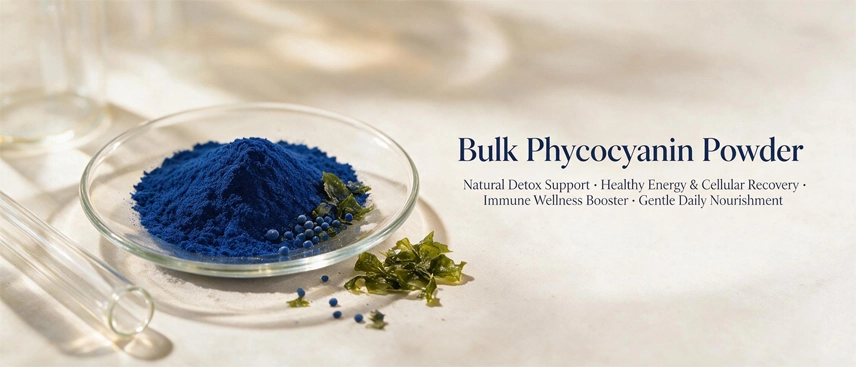
Bulk Phycocyanin Powder Benefits for Food, Beverage, and Supplement Manufacturers
A Natural Blue for Clean-Label Products
When you look outside, blue isn't always easy to find. The color FD&C Blue No. 1 was used by many brands. It is a man-made blue. People now pay close attention to ingredient lists and look for colors that come from plants. Bulk phycocyanin powder is a natural blue color that can be used with little to no water. Labels usually list "spirulina extract" instead of the name of an artificial dye. This helps businesses that say their goods are naturally colored. While clean labels are helpful, the formula as a whole is still important. Talk to a regulatory advisor about every ingredient and the final label text.
Applications Across Product Categories
People who make medicines use bulk phycocyanin powder in a lot of different areas. Food and drinks often use it to make ice cream, candy, gummies, smoothies, cold drinks, and dairy-free options. It is used as a supplement to food and comes in powder mixes, capsules, and drink mixes. They also test it in masks and serums as a natural colorant. Each group has its own set of rules. There are rules about how color additives can be used in food, different rules about how they can be used in cosmetics, and supplement labels must follow FDA rules. The first thing you should do is set the category of the finished product. This will tell you what grade, documents, and tests you need.
Supply Advantages of Buying Bulk Phycocyanin Powder
When they purchase in quantity, they obtain more than simply a lower price per item. Larger lots assist in keeping the shade consistent across manufacturing cycles if the batch specs are controlled by the supplier. They save money on packing and handling fees that have to be repeated as well. Planned quantities also help you plan when to create goods and help to reduce the chance of running out. If you are prepared to be flexible, you may start with tiny quantities to test the formula and then increase the quantity if authorised. BioSpark may manufacture a small quantity of things, or make a lot of them. From the production of the product to delivery to the client, we provide OEM and ODM services. Whatever provider you pick, be sure you know how they handle repeat orders.
The Technical Specifications Buyers Should Verify
Color Value and Purity
How much blue a powder gives off is shown by its color value. Most of the time, suppliers write it as E18 or E25 based on how much a 1% solution soaks up at about 618 nm. It means more color and less dosing when the number goes up. It's easy to see that E25 has almost 40% more color than E18. If you compare the absorbance of pigments to the absorbance of all proteins, the A618/A280 ratio is often used to show how pure something is. Some suppliers say that high-quality material has a ratio above 2.5. There are various ways to test something, so make sure you ask the supplier what method they use and what the value is on each batch COA.
Solubility, pH, and Heat Stability
Phycocyanin doesn't react with water, but how bulk phycocyanin powder works in real life may be different from how it works in a lab. For phycocyanin to be stable, temperature and pH play a big role, they found. In 2012, their study came out in the journal Process Biochemistry. Most suppliers say that pH levels between 5.0 and 7.5 are best. They also say that precipitation can happen below pH 4.0 and that the powder should be added after the heat treatment, since around 60°C is when denaturation can start. Low temperatures in solution can cause losses to begin, so make sure your method works. Check for haze, sediment, clumping, and color change after putting it away and exposing it to light. Some acidic drinks might need a shape that keeps them from moving around.
Contaminants, Microbiology, and Allergen Status
When you ask for the microbiological results, you should be told about things like the total plate count, yeast and mold, E. coli, and Salmonella. You should also ask the supplier if they check for cyanotoxins like microcystins because spirulina grows in water. You can say that a product is non-GMO, vegan, or organic if you look at documents that say it isn't any of those things. Before the first order, write down your goals and then compare the COA of each lot to those goals. This will help your clients and your brand stay safe.
How to Compare Bulk Phycocyanin Powder Options and Choose a Supplier
Compare Grade, Format, and Cost-in-Use
Place the color value, the dose, the certifications, the price, and the shelf life next to each other. Finally, write down how stable it is and how well it breaks down. It is not always easy to figure out the gross price. Let's say that an E25 powder gives off almost 40% more color than an E18 powder but costs 30% more per kilogram. When the batch is done, it might cost less. Also, keep the powder, liquid, and food-grade forms separate because they need to be tested and handled in different ways. Even though it says "natural" on it, it's not organic. Plus, you need a real record. Changes to pH, light, and temperature need to be made with more care for natural blue to work than for synthetic blue. Remember this as you compare the two.
Verify Manufacturer Credentials and Documents
Check to see if the company you're doing business with makes, sells, or trades bulk phycocyanin powder. Then, ask for papers that are important to your market. If they back up what you say, batch COAs, SDS files, allergen statements, and certificates like ISO, HACCP, GMP, organic, Halal, or Kosher can be helpful. Companies that make dietary supplements can't rely on a supplier's COA unless they do research on that supplier and keep an eye on the results. This goes against 21 CFR Part 111. The FDA Foreign Supplier Verification Program may also be needed by people who buy things in the US. Each certificate should match both the site where it was sold and the site where it was made.
OEM and ODM Support Matters
Providers of private-label bulk phycocyanin powder offer more than just the powder itself for projects. Find out who is in charge of coming up with the formula, making test batches, designing the packaging, looking over the artwork, and testing the final product. BioSpark can make dietary supplements, plant extracts, functional ingredients, nutrition formulas, and wellness products, as well as OEM and ODM products. They can help with everything, from coming up with an idea to giving you the finished item. We can also change the shapes of our products to fit our customers' needs, as long as it doesn't affect how much we can make. Write down the roles, requirements, and steps for approval for each partner, no matter who you pick. It's important to make sure that samples work with your real formula before you buy something. You should also ask the supplier how they handle changes to specifications after the product has been released.
Bulk Phycocyanin Powder Pricing, MOQ, Packaging, Use, and Storage
Pricing, MOQ, and Packaging
Prices vary based on the color, the amount of oil extracted, certifications, tests, the order size, how it is packed, where it is going, and terms such as FOB or CIF. To find out the MOQ for trial orders, samples, standard bulk lots, and private-label projects, you should ask what it is for each level. It is possible to learn about the different pack sizes and whether moisture barriers, labels, tamper protection, and palletizing are available. Some of the things that should be in your cost model are lead time, freight, insurance, duties, and customs forms. When do you think the goods will be ready to be sent? Think about how long they'll last in the US. Ask for these details to be added to the quote so that you can compare offers that are pretty much the same.
Common Mistakes When Buying Bulk Phycocyanin Powder
A great many people choose the least expensive option without first checking the dose and color value. A less expensive powder might need more of it to get the same shade. Also, it's not true that all natural blues are the same. They vary in shade, purity, pH range, and regulatory status. Some buyers choose a grade before reading the whole application. This makes it more likely that the person won't follow the rules and won't do well. When it comes to acidic drinks, where the color can fade or settle, some people don't do pilot tests. Another thing is that some people will take a COA without checking to see what site and batch it covers. With a simple checklist and a test run, you can avoid all of these problems.
Use and Storage Guidelines
Try it on a few different things to find the right dose. There are rules: the color, the pH level, the process temperature, and the thing that is being made tell you what level is right. Mix the powder with a liquid that will work with it before you use it. It will spread more easily this way. It's also up to you to decide what to put in and how to use it. Add it after the heat steps if you can. A lot of sellers say the powder will stay good for 24 months as long as it stays cool, dark, and dry. Get the exact number you asked for. When you open a container, make sure it's tightly closed again because oxygen, water, and light all make things less useful. Stock should be moved around based on when it goes bad. Also, keep track of each lot so you can find it.
Conclusion
Bulk phycocyanin powder adds a natural blue color to foods, drinks, supplements, and beauty products, but its value depends on thorough testing. Some of the most important checks are the product's color, purity, solubility, pH, and heat stability, as well as its source and identity. Documents that match the site where the product was made are also checked. Price per kilogram is not the best way to figure out value. Instead, you should compare cost per finished batch. There will be no change in supply as long as the supplier can meet the MOQ, package the goods well, and meet the lead time. It is less likely that things will lose their color and people will follow the instructions if they are written down and stored in the right way.
FAQ
What is bulk phycocyanin powder used for?
It turns some foods, drinks, supplements, and cosmetics blue. People who make things buy a lot of it.
How does it differ from whole spirulina powder?
It is made up of dried plant parts that are full of nutrients and green pigments. They took out the blue part and used phycocyanin, which is mostly used for color.
Is it stable in acidic beverages?
Things become less stable in acidic environments, and below pH 4.0, precipitation can happen. Find out about stabilized forms and do some test runs.
Which documents should a supplier provide?
You should ask for batch COAs, SDS files, allergen statements, and any other certificates that are needed for your claims.
How do MOQs work?
The MOQ is different for each grade and project. Ask for trial, sample, and bulk levels to be kept separate.
Request a Bulk Phycocyanin Powder Sample or Quotation from BioSpark
BioSpark’s bulk phycocyanin powder can help with both OEM and ODM projects. They also have a range of batch sizes and have exported to both North America and Europe before. You can get a sample or quote by emailing leao@biosparkcn.com with the product's use, the amount you want to order, and where you want it sent. Visit https://www.biosparkcn.com/ to learn more. What do you need? Our team will look it over and get back to you with the paperwork and terms that are needed for evaluation.
References
1. Applied Microbiology and Biotechnology, 2008: "Production of phycocyanin—a pigment with applications in biology, biotechnology, foods and medicine."
2. Process Biochemistry, 2012: "Stability of phycocyanin extracted from Spirulina sp.: Influence of temperature, pH and preservatives."
3. Process Biochemistry, 2014: "Thermal stability improvement of blue colorant C-phycocyanin from Spirulina platensis for food industry applications."
4. European Food Research and Technology, 2005: "Heat and light stability of three natural blue colorants for use in confectionery and beverages."
5. Federal Register, 2013: "Listing of Color Additives Exempt From Certification; Spirulina Extract."
6. Federal Register, 2007: "Current Good Manufacturing Practice in Manufacturing, Packaging, Labeling, or Holding Operations for Dietary Supplements."

Send Inquiry
You may like